


Self expandable stents for relief of venous baffle obstruction after the Mustard operation
- PMID: 9602654
- PMCID: PMC1728618
- DOI: 10.1136/hrt.79.3.230
Self expandable stents for relief of venous baffle obstruction after the Mustard operation
Abstract
Objective: Obstruction of the venous pathways after Mustard repair for transposition of the great arteries is associated with an increased risk of arrhythmia and sudden death. The purpose of this study was to assess the effectiveness of the largest (tracheal 22 x 40 mm) Wallstents in treating baffle obstructions.
Design: Retrospective analysis of patients with stented venous pathways.
Subjects: Eleven patients with baffle obstruction after Mustard repair for transposition of the great arteries.
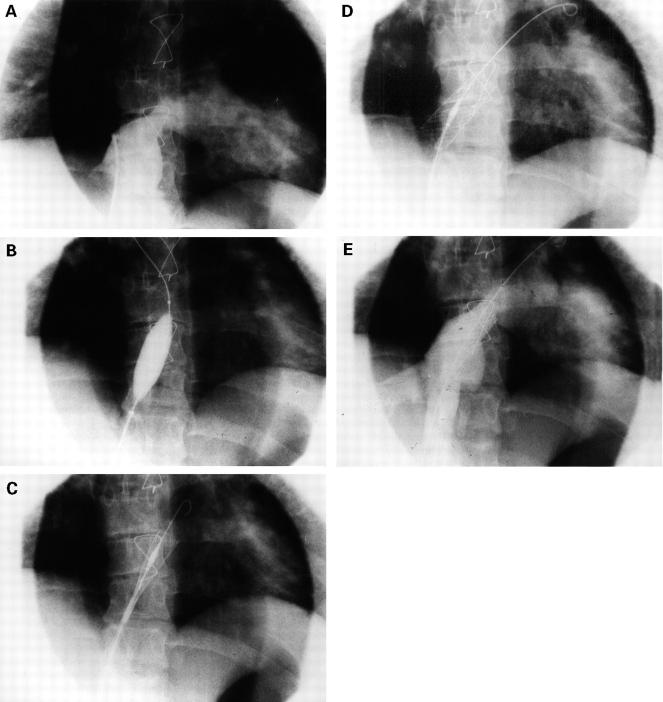
Interventions: Stenoses were dilated with an 18 or 20 mm balloon. However, recoil was noticed in 11 patients: immediately (n = 7) or on repeat angiography (n = 4). Eighteen stents were implanted (mean (SD)) 18 (3.3) years postoperatively. After dilatation a tracheal Wallstent (11.5 F) was deployed.
Main outcome measures: Relief of obstruction, haemodynamic improvement.
Results: In the inferior vena cava, 10 stents were deployed in seven baffle obstructions with an increase in diameter from 9.8 (2.4) mm to 16.5 (1.4) mm (p < 0.01) and a mean (SD) pressure gradient decrease from 5.1 (3.6) mm Hg to 1.4 (2.0) mm Hg; in the superior vena cava, eight stents were implanted increasing the diameter from 9.1 (3.7) mm to 15.6 (3.8) mm (p < 0.001) with a decrease in mean pressure gradient from 5.1 (2.7) mm Hg to 1.9 (1.5) mm Hg. No complications were experienced during implantation. No anticoagulation was prescribed. During follow up (1.7 (0.6) years; range, 0.9-2.6) no problems were noted; five patients were re-catheterised without change in measurements. There was no evidence of peal formation in any of the stents.
Conclusion: It is concluded that Wallstents are safe, easy to use, and effective in relieving baffle obstruction. Anticoagulation does not seem necessary.
Figures
Comment in
-
Stenting of systemic venous pathways after atrial repair for complete transposition.Heart. 1998 Mar;79(3):211-2. doi: 10.1136/hrt.79.3.211. Heart. 1998. PMID: 9602645 Free PMC article. No abstract available.
References
MeSH terms
LinkOut - more resources
Full Text Sources
Medical
